Missed Call Text Back: How It Works and What to Send
When you cannot pick up, a short text keeps the caller from moving on. Here is how it works, what to send, and when your phone needs more than a text.
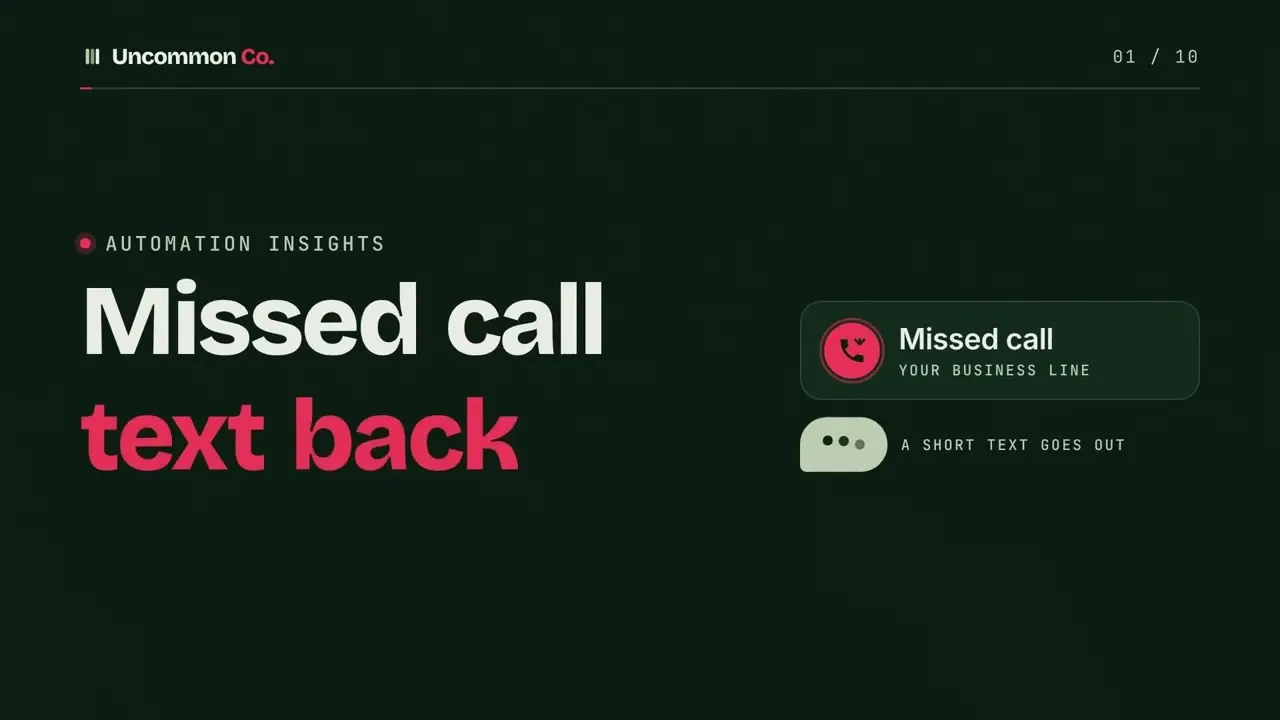
Missed call text back is an automation that sends a short text to anyone whose call you miss. The caller gets a message from your business within moments, saying who you are and how to continue, so they can reply by text instead of calling the next business on their list.
It is one of the smallest useful automations a local business can turn on. It is also easy to get wrong. At Uncommon Co. we look at the whole phone path before we build anything, and the text is only one piece of it. This guide covers how missed call text back works, what a good first text says, the rules to follow, and when your phone needs more than a text.
How it works
From missed call to a conversation
- 01A call to your business rings out
- 02Your phone system marks it missed
- 03A short text goes to the caller from your number
- 04The caller replies with what they need
- 05A person, or an assistant you approve, picks it up
The quick answer
- Turn it on if calls ring out while you are on a job, with a customer, or closed, and those callers matter to you.
- Write the message first. Name your business, say you missed them, ask one question, and include a way to opt out.
- Decide who owns the replies before you go live. An unanswered text is the same leak in a new place.
- Follow the texting rules. Keep the first text about their call, and expect to register your number for business texting in the US.
- Look past it if most of your calls need an answer right now. That is a job for a person or an AI voice assistant, with the text as a backup.
What is missed call text back?
Missed call text back (also called missed call auto reply or text back) is a rule in your phone system. When a call to your business goes unanswered, the system sends a text message you wrote ahead of time to the number that called.
That text does three jobs. It tells the caller they reached the right place. It gives them an easy way to continue without calling again. And it gives your team a written thread to pick up, instead of a voicemail that may never be left.
It is not an answer to the caller’s question. It is a way back into the conversation. What happens after the caller replies decides whether it was worth turning on.
How missed call text back works
The mechanics are simple:
- A call rings out. Nobody answers within the ring time you set, the line is busy, or you are closed.
- The system marks it missed. Your phone system or the software watching your line sees the final missed status.
- The text goes out. The caller gets your message, ideally from the same number they called, so they recognize it.
- The caller replies. They say what they need, ask a question, or ask for a call back.
- Someone picks it up. A person on your team, or an assistant you approve, answers the reply and moves it to the next step.
What you need in place
- A number that can send texts. Some business lines only take calls. Check with your phone provider before anything else.
- A trigger you trust. Know whether the text fires on a missed call, a voicemail, after hours, or all three, and test each one.
- A message for open hours and one for closed hours. The same text rarely fits both.
- An owner for replies. A named person, a shared inbox someone actually watches, or an assistant with clear handoff rules.
- A rule for repeat callers. Some systems text on every missed call, even when the same person calls twice in a row. HighLevel’s own setup guide for missed call text back warns about this and suggests adding a wait step or filter so one caller does not get several texts.
When it helps
Missed call text back earns its keep when missed calls are real leads and the caller can wait a little for a reply. Common cases:
- You work with your hands. You are under a sink, on a roof, or with a client, and the phone rings anyway.
- Small team, busy hours. Everyone is with a customer at the same moment the phone rings.
- After hours. Calls come in at night or on weekends and would otherwise go to a voicemail box.
- Callers who prefer text. Some people would rather type what they need than leave a message.
In each case the text keeps the door open until a person can step in.
When a text back is not enough
A text back is an acknowledgment, not an answer. It falls short when:
- The caller needs help now. An urgent caller should get a phone path to a person, not a text thread. If you handle emergencies, say how to reach someone in the text itself.
- Nobody answers the replies. If a reply sits for hours, you have moved the leak, not fixed it.
- The number cannot get texts. Landlines and some blocked or business numbers will never see your message. Callers who do not text need a call back.
- Most calls are routine questions. If people mostly call for hours, directions, or booking, it is often better to answer the call in the first place. That is what an AI voice assistant does.
- The lead goes quiet after the first reply. One text does not follow up. That is a job for lead follow-up.
What a good first text says
The first text
A weak text vs a good one
Weak
We received your call. A representative will be in touch.
- No business name
- No next step for the caller
- No time frame, no way out
Better
Hi, this is [Business]. Sorry we missed your call. What can we help with? Reply here and we will get back to you today. Reply STOP to opt out.
- Says who it is and why they got it
- Asks one question
- Promises only what your team can keep
A good first text does four things:
- Says who it is. Your business name, so the caller knows why they got it.
- Acknowledges the call. “Sorry we missed your call” is enough.
- Asks one question. What do they need? Is it urgent or can it wait? One question gets more replies than a menu.
- Sets an honest expectation. Only promise a reply time someone is assigned to keep.
Add an opt-out line such as “Reply STOP to opt out.” It is a courtesy, and carriers expect it.
Two examples you can adapt (samples, not real customer messages):
| When | Example text |
|---|---|
| Open hours | Hi, this is [Business]. Sorry we missed your call, we are with a customer. What can we help with? Reply here and we will get back to you today. Reply STOP to opt out. |
| Closed | Hi, this is [Business]. We are closed right now and will reply when we open. Tell us what you need here. For an emergency, call [number]. Reply STOP to opt out. |
Keep it short and plain. It should sound like a person at your business wrote it, because one did.
How to set it up
- Check your number. Ask your phone provider whether your business number can send texts, and from which system. If it cannot, decide whether to add texting, move the number, or forward unanswered calls to one that can.
- Pick where it lives. Many phone systems, CRMs, and texting tools include missed call text back as a setting. Use the one your team already works in, so replies land where people look.
- Register for business texting if needed. In the US, sending texts from a standard local number through business software usually means registering for A2P 10DLC (more on that below).
- Write the open and closed messages. Use the four parts above. Have someone outside the business read them.
- Set the rules. Ring time before it counts as missed, hours, repeat-caller filters, and which numbers never get a text (your own staff, for example).
- Name the reply owner. Who answers, how fast, and what happens on days off.
- Test it from a mobile phone. Call, let it ring out, check the text arrives from the right number, reply, and confirm the reply lands where your team will see it.
- Review it after launch. Read the threads. Fix the message, the hours, or the handoff based on what callers actually send.
The rules to follow: consent, opt-out, and registration
This is general information, not legal advice.
- Consent. The FCC’s guide to unwanted robocalls and texts says autodialed texts to a mobile phone need the owner’s consent, that commercial texts require written consent, and that people may opt out at any time in any reasonable way. Keep the first text about the call they just made. Do not slip a promotion into it, and get advice before you add marketing messages.
- Opt-out. Honor STOP replies right away. The wireless industry’s CTIA Messaging Principles and Best Practices are the guidelines carriers point businesses to for consent, opt-out, and avoiding unwanted messages.
- A2P 10DLC registration in the US. Twilio’s A2P 10DLC documentation explains that US carriers treat texts sent through business software as application-to-person traffic, and that anyone sending those texts from a standard 10-digit local number must register a brand and a campaign. Many providers handle this for you, but ask. Unregistered texts can be filtered or blocked, so the caller may never see your message.
How it fits with an AI receptionist and lead follow-up
Where it fits
Text back is one piece of the phone
- Before the missAI voice assistantAnswers the call, gives approved answers, books or hands off. Fewer calls get missed at all.
- At the missMissed call text backA short text when nobody picks up, so the caller has a way back in.
- After the replyLead follow-upFollows up when the lead goes quiet, routes hot leads to a person, logs notes.
Missed call text back covers one moment: the call nobody picked up. Two other pieces cover the moments around it.
- Before the miss: an AI voice assistant. It answers the call, gives approved answers, takes a message, helps book, and hands off to a person when the call needs one. Fewer calls get missed in the first place. This is what we build on our AI voice assistants and virtual receptionists page. If you are weighing it against a live answering service, see AI receptionist vs answering service.
- After the reply: lead follow-up. When a caller replies once and goes quiet, follow-up sends the next useful message at the right time, routes hot leads to a person fast, and logs notes so the team knows what already happened. That is our sales and lead nurturing work.
You do not need all three on day one. Start where your calls actually leak. If most missed callers just need a reply later, a text back may be the whole first step. If most need an answer now, voice is the better first move, with the text as the safety net.
Mistakes to avoid
- No owner for replies. The most common failure. Decide who answers before you switch it on.
- A robotic message. “Your call is important to us” reads like a form letter. Write like a person.
- Promises you cannot keep. “We will call you in 5 minutes” sets up a broken promise on your busiest day.
- No emergency path. If urgent calls are possible, put a phone path in the closed-hours text.
- Marketing in the first text. Keep it about their call. Ask before you send anything else.
- Skipping registration. Unregistered business texts can be filtered, and you will not know the caller never saw it.
- Texting everyone. Exclude staff, vendors, and repeat calls within a short window.
- Never testing. Call your own number from a mobile phone, after hours too, before you trust it.
- Automating a mess. If nobody knows who calls back today, a text will not fix that. Fix the process first.
What Uncommon Co. can do for you
We come in as your AI Concierge. We find the first move that matters, then we build it with you. For missed calls, that can be a well-set-up text back, an AI voice assistant that answers in the first place, follow-up that keeps the lead warm, or a mix. These are the pieces we build:
- AI voice assistants and virtual receptionists. Greets the caller, answers common questions from your approved facts, takes a message with clear notes, helps book an appointment or request a callback, and hands off to a person when the call needs one.
- Sales and lead nurturing. Follows up when a lead goes quiet, sends the next useful message at the right time, routes hot leads to a person fast, and logs notes your team can see.
- AI chat. The same approved answers on your website, for people who would rather type than call, with a handoff to a person.
- Back-office and operations agents. Moves the details from a call or text into the systems you already use, with a person approving the judgment calls.
- Skill building for your team. So the people who own the replies know how the setup works and how to change it.
Where we shine
- We start with your calls, not a software catalog. We look at when calls get missed and what those callers wanted before we recommend anything. We do not automate a mess.
- Approved facts only. If an assistant answers the replies, it answers from what you approve. If it does not know, it does not guess.
- AI says it is AI. Every assistant we build tells people up front, as written in how we work.
- A person stays in charge. Who owns replies, and when a person takes over, is set before launch, not after.
- A careful launch. Testing with your team, launch only after your approval, and review and tweaks after go-live.
- One first step. One piece that earns its keep, not a pile of tools.
Here is how we would set it up with you.
AOA: Audit. Optimize. Automate.
How we would set this up with you
- 01AuditLook at when calls get missed and what those callers wanted. Find the real leak.
- 02OptimizeWrite the message, name who owns replies, set hours and the urgent-call path.
- 03AutomateTurn on the text back, and voice or follow-up if it earns its keep.
We do not automate a mess.
AOA Audit. Optimize. Automate.
How we would approach this
We do not automate a mess. Every engagement runs the same three steps.
- 01
Audit
Find what is already leaking time, money, or leads, and where AI should touch first.
- 02
Optimize
Fix the process before you automate the mess.
- 03
Automate
Build the piece that earns its keep, with a person keeping judgment on the work.
Frequently asked questions
What is missed call text back?
Missed call text back is an automation that sends a short text message to a caller when nobody answers their call. The text says who you are, that you missed them, and how to continue. The caller can reply by text instead of leaving a voicemail or calling someone else.
How does missed call text back work?
Your phone system notices that a call to your business number went unanswered, then sends a text you wrote ahead of time to the number that called. The caller replies, and the reply lands in an inbox that a person, or an assistant you approve, keeps an eye on. It only works if your number can send texts and someone owns the replies.
Do I need permission to text people who called me?
The rules depend on what the text says and how it is sent. The FCC says autodialed texts to a mobile phone need the owner's consent, and commercial texts need written consent. Keep the first text about the call they just made, not a promotion, include a way to opt out, and get legal advice before you add marketing messages.
Does missed call text back work with my current business number?
Often, but not always. Some numbers can only take calls. You may need to turn on texting with your phone provider, move the number to a system that can send texts, or forward unanswered calls to one that can. In the US, texting from a standard local number through business software usually means registering for A2P 10DLC.
What should a missed call text say?
Name your business, say you missed their call, ask one simple question, and set an honest expectation for when you will reply. Add an opt-out line. Do not promise a callback time your team cannot keep, and give urgent callers a phone path, not a text thread.
Is missed call text back the same as an AI receptionist?
No. A text back reacts after a call is missed. An AI receptionist answers the call in the first place, gives approved answers, and books or hands off to a person. Many businesses start with a text back and add voice later, or use both, with the text as the backup when a call still slips through.
Can the replies be answered automatically?
They can, if you set rules for what may be answered and what goes to a person. An assistant should only answer from facts you approve, say that it is AI, and hand off anything urgent, upset, or unclear. If it does not know, it should not guess.